The final thing that confronts you as you leave Tracey Emin: A Second Life at the Tate Modern is the telephone number of a sexual-abuse charity. It is both a responsible warning and a neat summary of what you have just experienced: an exhibition steeped in underage sex, male exploitation, abortion, poverty and shame, with strategically placed seats for anyone who feels faint.
If you love London exhibitions, you may enjoy our post on London’s Free Art galleries.
My Bed – An Ode to Slovenly Housekeeping
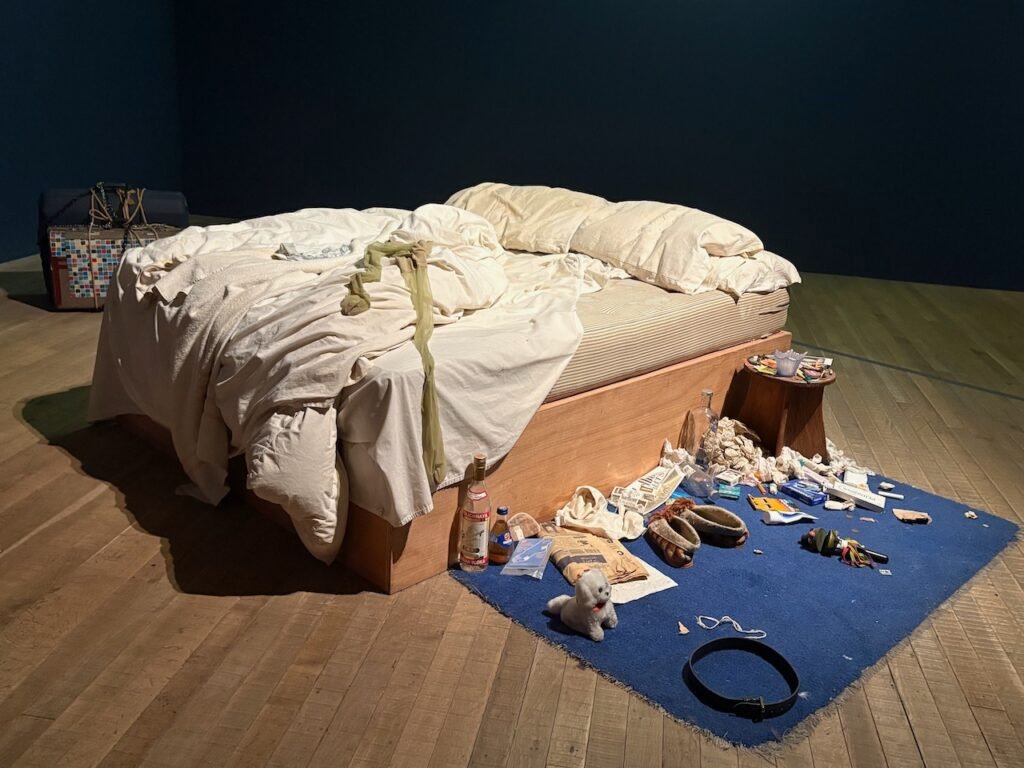
It culminates, inevitably, in My Bed: the grubby monument to poor housekeeping that made Emin famous. There it is, complete with grimy sheets, condoms and sticky scraps of toilet paper that she apparently could not be bothered to put in the bin.
Famous for what, exactly?
I went with a friend who had been a health visitor. I caught her studying the bed and murmuring, with professional recognition rather than artistic awe, “A lot of people live like that.”
Tracey Emin’s Signature Twiggy Daubs
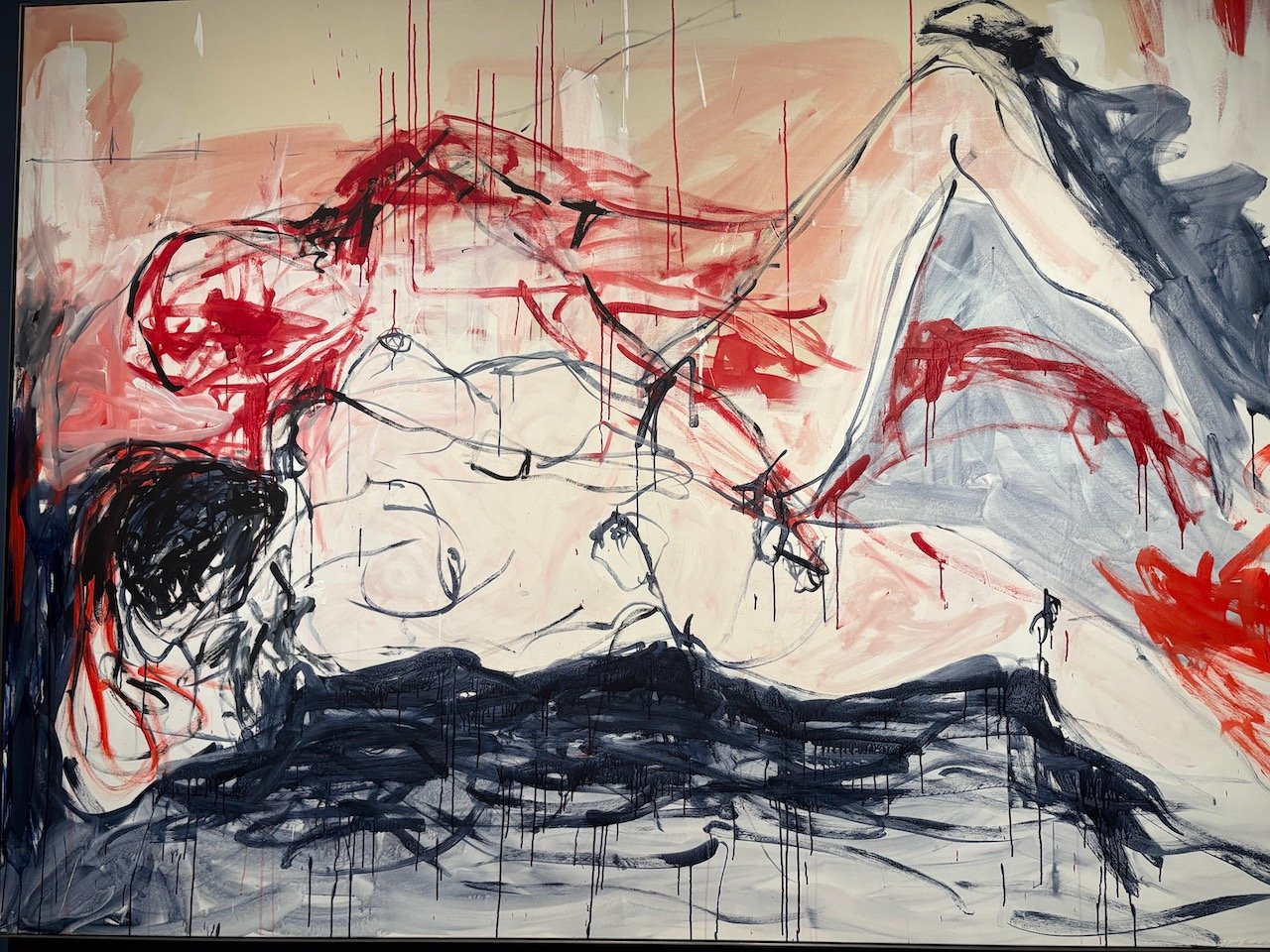
The paintings are unmistakably Emin. Huge signature canvases—many of which sell for extraordinary sums—featuring scratchy red-and-black figures that look as though they were drawn with twigs. Paint is then violently slapped across them, partially obliterating the bodies and their memories. Finally, to add a dash of extra anguish, she defaces the canvas with words such as “Fucking” or “Cunt.”
She is Margate’s finest.
Skip the Canvases, Watch the Videos
Yet despite the exhibition being almost sold out, I saw remarkably few people standing back and studying the paintings. The crowds were gathered around the video installations. This may be the central problem with Emin’s art: without her lurid autobiography, how much of the art remains?
In the first video, a fresh-faced, thirty-something Tracey Emin, wearing a red jumper, blue shorts and Dr Marten boots, dances with tremendous energy while recounting how she skipped school, spent her days in local cafés and had sex on the beach and in alleys with the town’s youth who later followed her around chanting “slapper” and other insults.
In the second, she appears older and more guarded, wearing a second-hand jacket and a quasi-intellectual pair of glasses. She recalls her abortion and observes that where she came from, you had arrived if you were seventeen, had two children and were on the waiting list for a council house.
This is where the exhibition becomes more interesting and troubling than a collection of dirty sheets and expensive scrawls. We are not simply being shown the work of Dame Tracey Emin, the successful artist and Royal Academician. We are being invited to inspect the exposed inner life of a girl with desperately low self-esteem, growing up amid poverty and limited expectations, whose sexual voracity appears to have made her a target for male exploitation.
As a fan of modern art, you may want to visit Leake Street Tunnel, a free graffiti tunnel near the Tate Modern.
We the Unwitting Voyeurs of Trauma as Spectacle
Emin has spent much of her career returning to that girl, displaying her wounds and asking us to keep on looking. The art establishment has been delighted to oblige. Her private distress has become her trademark, while galleries turn it into a prestigious cultural event and charge us £22 to witness it.
That leaves an uncomfortable question: are we looking at art, autobiography or trauma repackaged as spectacle?
Emin’s admirers might argue that this is precisely her achievement. She dragged abortion, sexual shame, female desire, mental collapse and the unlovely realities of women’s bodies into galleries that had traditionally excluded them. She made experiences that were private, humiliating and unspeakable impossible to ignore.
But disclosure is not always art, and pain is not always profound. Nor does repeatedly exhibiting wounds necessarily transform them. Sometimes it merely exhibits them.
The other big art show of the season is the Royal Academy Summer Exhibition, and we give you tips to make the most of it.
Even before we entered, I suspected controversy and debate. At the box office I asked, “Do you have two tickets for Tracey Emin? We want to argue.” I pointed at my friend. All the cashiers laughed. They knew!
Talented or Self-Regarding? Brian Sewell Decides
The late art critic Brian Sewell famously dismissed Emin’s work as “talentless, self-regarding and a parading of private distress.” The description is cruel, but standing amid the videos, confessions, angry figures and soiled bed linen, it is difficult not to agree.
Perhaps the real achievement is not that Emin turned adolescent suffering into art, but that she turned it into celebrity, cultural importance and a highly lucrative brand. The more degraded the memory, the greater its apparent authenticity; the more private the anguish, the more eagerly the audience presses forward to see it.
So the question is not simply whether you want to spend £22 looking at Tracey Emin’s bed. It is whether you want to participate in the transformation of an exploited teenager’s distress into public entertainment.
Personally, I came away feeling less like an exhibition-goer and more like a voyeur—with better things to do with my day.
Tracey Emin: A Second Life Opening Times, Ticket Prices and Cheaper Admission
Tracey Emin: A Second Life runs until 31 August 2026 at Tate Modern, Bankside, London SE1 9TG. Tate Modern is open 10am–6pm Sunday to Thursday and 10am–9pm on Fridays and Saturdays.
Adult tickets are £22 including the optional donation—select the £20 non-donation price when booking if you prefer. Concessions are available, while holders of a National Art Pass receive 50% off. Book through the official Tate website.
Tate Members enter free. Anyone aged 16–25 can join Tate Collective free of charge and buy exhibition tickets for £5, including tickets for up to three friends. Universal Credit and Pension Credit tickets may also be available for £5. Alternatively, check National Rail’s Days Out Guide for a possible 2-for-1 offer when travelling by train. Entry to Tate Modern’s permanent collection remains free.