

When the curtain rose on English National Opera’s production of Gluck’s Iphigénie en Tauride, I was all set to hate it.
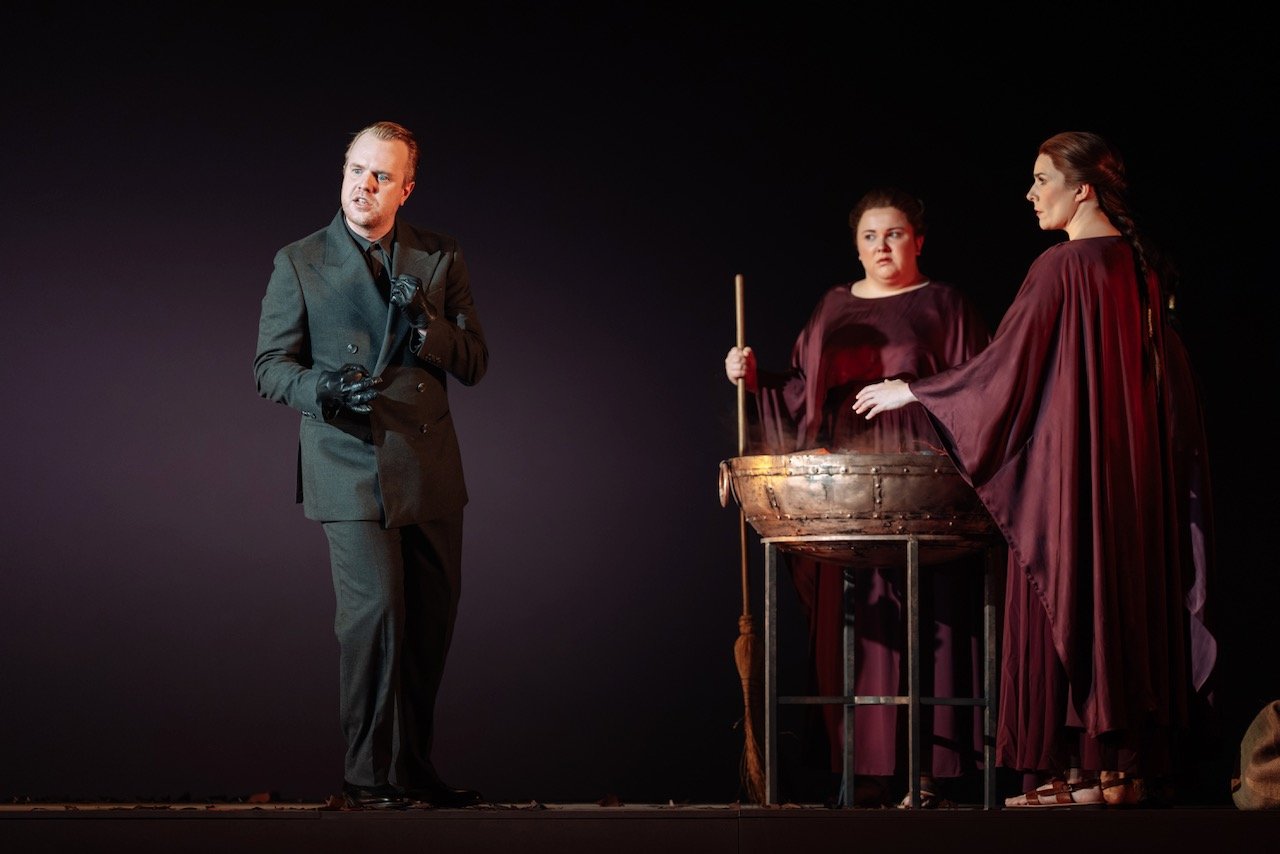
A group of women dressed as Grecian priestesses wandered aimlessly around the stage, gazing into the middle distance. It looked rather like something a group of school pupils might have devised for their O-level drama examination. All the women wore identical burgundy Grecian costumes resembling a bridal party, making it hard to distinguish Iphigénie herself.
With ENO’s financing difficulties and its move to establish a presence in Manchester, I’ve grown accustomed to increasingly minimalist productions. This one seemed to be taking minimalism to extremes. The men wore ordinary suits, the sets were virtually non-existent, and there was precious little in the way of spectacle. This was a sharp contrast to the technical achievements of Angel’s Bone which opened the Coliseum’s opera season.
I settled down expecting a disappointing evening.
How wrong I was.
As the opera progressed, I found myself becoming increasingly absorbed. Gluck’s music has an extraordinary dramatic power, with great surges of bellicose orchestral sound that drive the action forward. It is clear how Gluck became such a powerful influence on Wagner. Indeed, there were moments when the orchestra almost overwhelmed Morgan Pearse, singing the role of Thoas.
But what initially appeared to be a rather threadbare production gradually revealed itself as something quite remarkable.
The turning point came with the scenes involving the two Greek prisoners, Oreste and Pylade, sung by Jacques Imbrailo and Nick Pritchard. Here the combination of acting, singing and direction was absolutely gripping. The relationship between the two men, each prepared to sacrifice himself for the other, was extraordinarily moving.
Suddenly, the absence of elaborate scenery ceased to matter. The drama was entirely in the music and the performances. I found myself completely caught up in the story, desperate to discover what would happen next.
Christine Rice was magnificent as Iphigénie. A stalwart of the operatic stage, with an enormous range of roles behind her, she brought both authority and vulnerability to the part. She was entirely convincing as a woman haunted by her family’s terrible history and struggling with an impossible moral dilemma. Her performance was one of the great pleasures of the evening.
David Bates conducted the ENO orchestra with tremendous energy and an unerring sense of pace. The music never lost its momentum, and the mounting dramatic tension was beautifully sustained.
What made the evening so successful was the extraordinary sense of teamwork. Lyndsey Turner’s direction, the casting, the acting and the musical performances came together in a way that made the simplicity of the staging and costumes almost irrelevant.
And, after so much anguish, murder and threatened sacrifice, what a pleasure to have an opera with a happy ending!
The audience clearly shared my enthusiasm. The production was received with tremendous warmth, and deservedly so.
I had arrived expecting to dislike almost everything about this production. I left thinking that I had witnessed something rather special.
Sometimes, in opera, less really is more.
______________________________________________________________________________________________________________
English National Opera’s production of Gluck’s Iphigénie en Tauride runs for 4 performances on 6, 9, 11 and 14 November 2026.
Tickets start from £15
Purchase tickets from the ENO website.


